Language

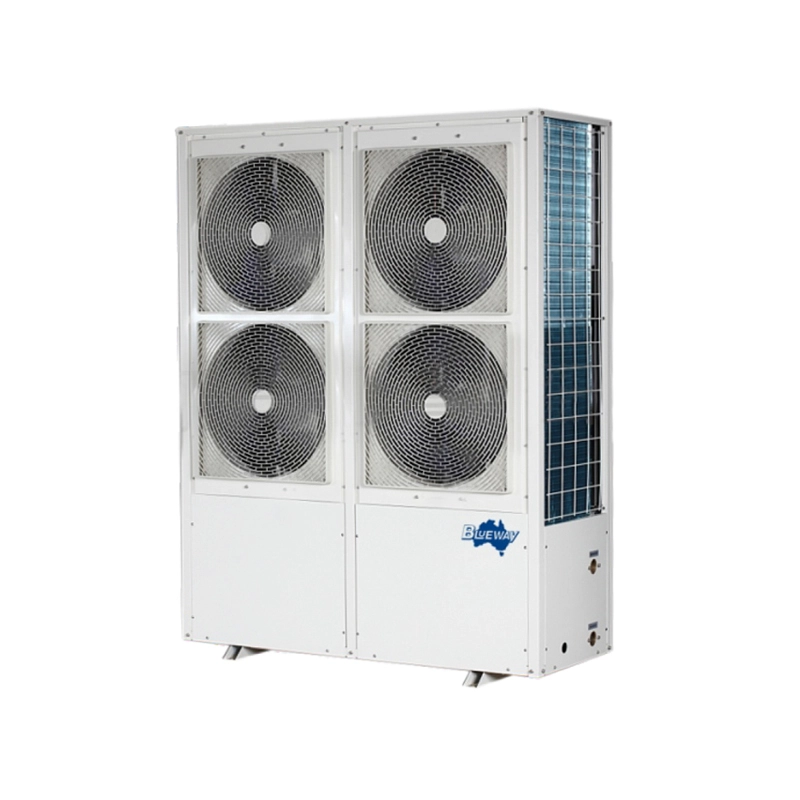
This product family belongs to Blueway’s Air Conditioner range, supported by our Customized HVAC Fabrication capability.
A standard air conditioner does one job: it moves heat from indoors to outdoors. A heat pump air conditioner does the same job — and then reverses the refrigerant cycle to move heat in the opposite direction, from outdoor air into the building.
That reversal is the entire difference. The same compressor, the same coils, the same refrigerant circuit, the same indoor unit. What changes is a four-way valve that swaps the roles of the evaporator and condenser, allowing the system to heat as well as cool.
In practical terms, this means one installed system replaces two: the air conditioner you would have bought for summer, and the boiler, furnace or electric heater you would have bought for winter. That is not a minor convenience — it changes the installation cost, the roof or plant room space required, the maintenance scope, and the energy profile of the building.
| Aspect | Cooling Mode | Heating Mode |
|---|---|---|
| Heat flow direction | Indoor → outdoor | Outdoor → indoor |
| Indoor coil role | Evaporator — absorbs indoor heat | Condenser — releases heat indoors |
| Outdoor coil role | Condenser — rejects heat to outdoor air | Evaporator — absorbs heat from outdoor air |
| Four-way valve position | Cooling position | Reversed position |
| Defrost requirement | Not applicable | Required in cold, humid conditions |
| Typical efficiency metric | EER / SEER | COP / HSPF |
| Low ambient limitation | High ambient affects capacity | Low ambient reduces capacity and COP |
| Main comfort factor | Cooling speed and humidity removal | Supply air temperature and defrost behavior |
Cooling performance is generally easier to achieve. Heating performance in cold weather is where the engineering quality of a heat pump air conditioner becomes visible — and where product selection matters most.
As outdoor temperature drops, a heat pump has less heat available to absorb from the air, and the compressor must work against a larger pressure ratio. Capacity falls, COP falls, and in humid cold conditions the outdoor coil begins to frost.
How a unit handles this determines whether it is a genuine year-round heating solution or only a mild-winter supplement.
Vapor injection cools the compression process and increases refrigerant mass flow, allowing the compressor to operate effectively at low ambient temperatures. This is the same principle used in Blueway’s low-ambient heat pump models, applied here to space heating.
Demand-based defrost activates only when frost actually affects performance, rather than on a fixed timer. This reduces unnecessary defrost cycles, which are a major source of efficiency loss in cold and humid climates.
Instead of switching on and off at fixed capacity, the compressor modulates to match actual heating demand. This maintains stable indoor temperature, reduces starting current, and improves seasonal efficiency — especially in partial-load conditions, which represent most of the heating season.
R32 and R290 offer favorable thermodynamic properties for heating operation, alongside lower global warming potential compared with R410A. Selection depends on capacity, charge size, safety requirements and local market regulations.
| Application | Recommended Configuration |
|---|---|
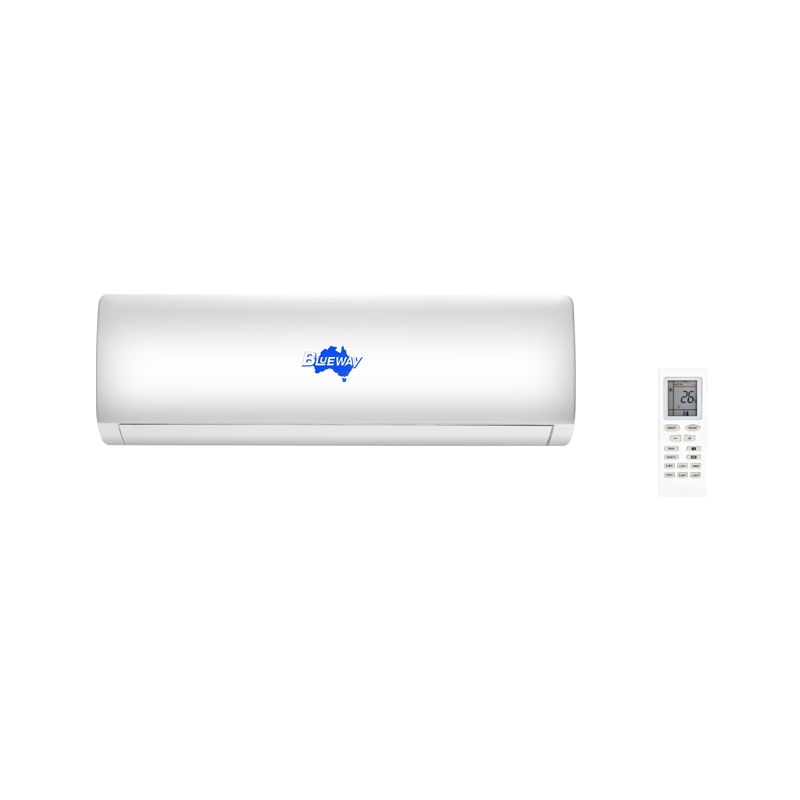
| Single bedroom or small apartment room | Split wall-mounted, single zone, inverter |
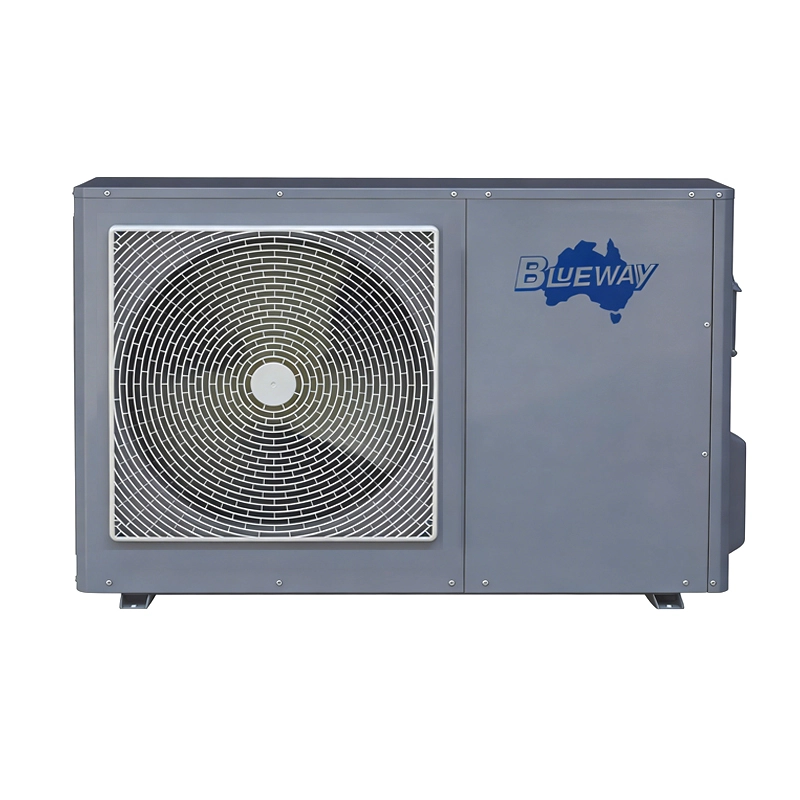
| Multi-room residence | Multi-split outdoor unit with individual indoor units, or ducted system |
| Villa with multiple floors | Ducted or multi-split with zoning control |
| Hotel guest rooms | Ducted or cassette, central controller, room-by-room setpoint |
| Office with suspended ceiling | Cassette or ducted, BMS integration |
| Retail shop or restaurant | Cassette or floor-standing, high-capacity model |
| Cold climate region | Low-ambient model with EVI, enhanced defrost control |
| Hot climate region | High-ambient configuration, corrosion protection options |
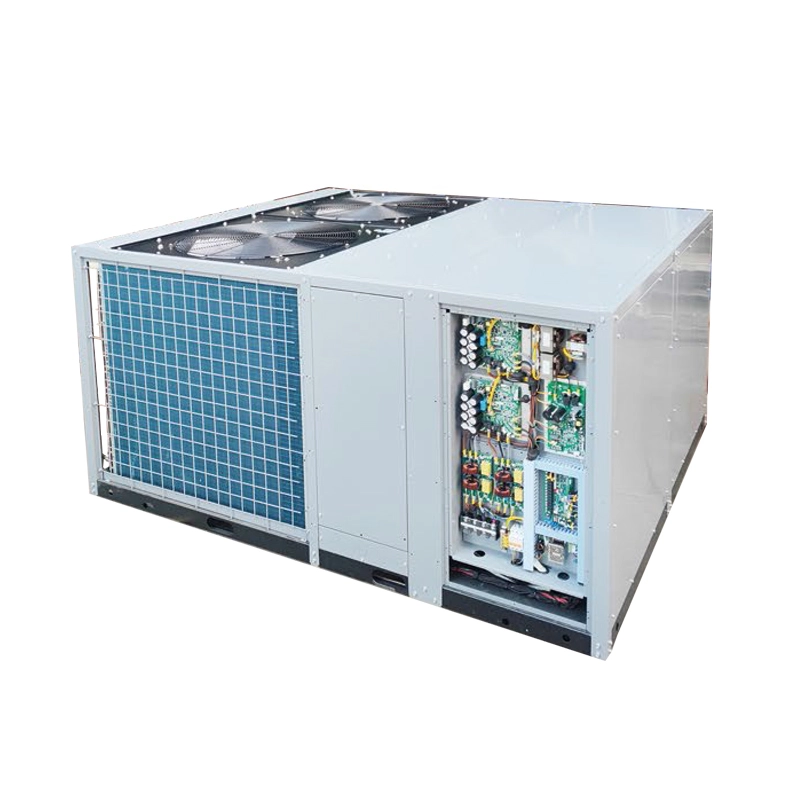
| Building with limited indoor plant space | Rooftop package unit connected to ductwork |
| OEM equipment integration | Custom dimensions, refrigerant and control interface |
All values are typical and for reference only. Final specifications depend on the confirmed datasheet, configuration and project requirements.
Is a heat pump air conditioner the same as a normal air conditioner?
It uses the same basic components, but includes a reversing valve that allows the refrigerant
cycle to operate in both directions. This enables heating as well as cooling from the same
system.
Can it replace a boiler or furnace completely?
In many climates yes, particularly with a low-ambient model. In very cold regions, it may be
more practical to use the heat pump as the primary heating source with a backup heat source
for the coldest periods. The right approach depends on your climate and building load.
How does heating efficiency compare with electric heaters?
A heat pump moves heat rather than generating it by resistance. Even in cold conditions, this
typically results in significantly lower energy consumption than electric resistance heating
for the same delivered heat.
What happens during defrost in winter?
In cold, humid conditions, frost can form on the outdoor coil. The unit temporarily reverses
the cycle to melt the frost, then returns to heating. Modern demand-based defrost logic
minimizes the frequency and duration of these cycles.
Can one outdoor unit serve multiple indoor units?
Yes. Multi-split configurations allow a single outdoor unit to serve several indoor units,
each with independent temperature control. This is common in apartments, villas and small
commercial spaces.
Which refrigerant is best for my market?
It depends on local regulations, capacity requirements and service infrastructure. R410A is
widely established, R32 offers improved efficiency and lower GWP, and R290 offers very low
GWP subject to charge size and safety requirements. We will recommend based on your market.
Do you support OEM / ODM?
Yes. Blueway provides OEM, OBM and ODM services with customized branding, capacity, voltage,
frequency, refrigerant, control interface and cabinet design.
For dedicated hot water production, see our Hot Water Heat Pump range. For combined space heating, cooling and domestic hot water, view the Heating Cooling Heat Pump series. For swimming pool heating, explore the Swimming Pool Heat Pump range.
For customized system design and equipment fabrication, explore our Customized HVAC Fabrication capability, or browse the full Products overview.
Blueway was founded in 1993. Our manufacturing center is located in Shunde, Foshan, Guangdong, China, focusing on the HVAC industry and integrated energy-saving solutions. Over 30 years, Blueway has supplied and exported heating and cooling systems to more than 40 countries and regions, serving hotels, engineering companies and industrial projects.
Tell us your room or building layout, climate conditions, cooling and heating requirements, and preferred indoor unit type — we will come back with a matched air conditioner heat pump solution.



Teams