Language
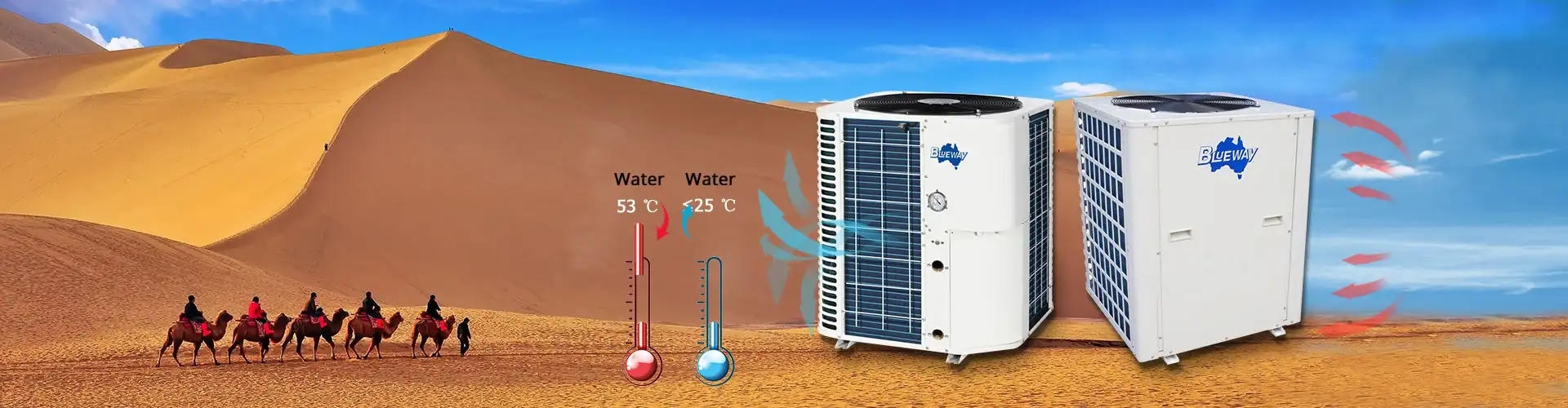
This product belongs to Blueway’s Swimming Pool Heat Pump family, which covers pool water heating, dehumidification and complete pool hall climate control. For water-only pool heating, see the standard pool heat pump range.
From an HVAC perspective, an indoor pool hall is one of the most difficult spaces in any building. It is not simply a big room that needs cooling. It is a continuously operating evaporation surface, inside a sealed envelope, filled with chlorinated air, occupied by people in minimal clothing, surrounded by materials that can be damaged by moisture.
Four physical processes are constantly at work, and all four must be managed at the same time:
Pool water evaporates into the air every hour of every day, including at night when the pool is empty. The rate depends on water temperature, air temperature, air velocity over the surface, and the difference in humidity between the water surface and the air above it. A typical indoor pool releases tens of liters of water into the air each day.
That evaporated water becomes latent load. If it is not removed, relative humidity climbs toward saturation. The space feels heavy and sticky, sweat does not evaporate from swimmers, and the air becomes uncomfortable regardless of temperature.
Moisture in the air will condense on any surface below the dew point. In a pool hall, that includes windows, exterior walls, structural steel, ceiling panels, ductwork, light fixtures and plumbing pipes. Over time, condensation causes corrosion, mold growth, paint failure, and structural deterioration.
Chlorine disinfectants react with organic matter to form chloramines, which are the source of the characteristic "pool smell" and are irritating to eyes and respiratory systems. These compounds are also highly corrosive to standard air conditioning coils, cabinets and electrical components.
A standard comfort air conditioner cannot handle any of these four conditions adequately. This is why indoor pool halls need a dedicated system.
| Issue | Standard Comfort Unit | Dedicated Pool Unit |
|---|---|---|
| Coil corrosion | Standard copper-aluminum coil corrodes within 1–3 years in chlorinated air | Corrosion-resistant coil coating and cabinet treatment as standard |
| Dehumidification capacity | Limited — sized for comfort cooling, not evaporation load | Sized specifically for pool evaporation and occupancy latent load |
| Air distribution | Direct supply air blows onto occupants | Designed to avoid draft on wet swimmers, distribute air across surfaces |
| Fresh air handling | Minimal or none | Controlled fresh air intake to limit chloramine buildup |
| Surface condensation | Not addressed — windows and walls sweat | Airflow directed at glazing and surfaces to prevent condensation |
| Operating hours | Intermittent, occupancy-based | Continuous — moisture must be removed even when the pool is empty |
| Setpoint logic | Temperature only | Temperature and humidity control simultaneously |
| Water heating integration | None — separate system required | Integrated heat recovery to pool water where configured |
| Energy recovery | None | Condenser heat can be recovered to pool water or space heating |
| Service life | Short — corrosion and continuous overload | Extended — designed for the pool environment |
The result of using a comfort unit is usually the same: it works for the first season, corrodes through the second, and is replaced by the third — while the building continues to suffer moisture damage throughout.
This is the primary function. Moisture must be continuously removed from the air, even at night when the pool is not in use and even in winter when the space is being heated. Dehumidification is not an occasional activity — it is the baseline operating mode.
Air temperature in the pool hall must be maintained within a comfortable range — typically slightly above water temperature to limit evaporation and avoid the sensation of cold when stepping out of the water. In summer, the space may need cooling; in winter, heating. The system must handle both.
When the system is dehumidifying, it is absorbing heat from the air. Rather than rejecting that heat outdoors, it can be transferred to the pool water. This heat recovery is one of the most significant efficiency advantages of an integrated pool climate system, because it uses energy that would otherwise be wasted.
Fresh air must be introduced to dilute chloramines and other airborne contaminants. The amount is determined by bather load, pool surface area and the chloramine concentration that can be tolerated. Ventilation also affects energy consumption, so the control strategy must balance air quality against operating cost.
All values are typical and for reference only. Final specifications depend on pool size, water surface area, water temperature, bather load, building envelope and local climate.
| Factor | Why It Matters |
|---|---|
| Pool surface area | Directly determines evaporation rate — the largest single factor in system sizing |
| Water temperature | Higher water temperature increases evaporation and latent load |
| Air temperature setpoint | Affects evaporation rate and swimmer comfort |
| Relative humidity setpoint | Lower RH requires more dehumidification capacity |
| Air velocity over water surface | Higher air speed increases evaporation significantly |
| Bather load | Adds latent load through respiration and wet bodies |
| Building envelope | Insulation, glazing area and thermal bridging affect condensation risk |
| Glazing area and type | Large glazed areas lose heat and are the first surface to condense |
| Ventilation requirement | Determines fresh air load and exhaust strategy |
| Local climate | Affects heating, cooling and dehumidification demands through the year |
Can I use a normal air conditioner in my pool hall?
It is not recommended. Standard units are not designed for continuous dehumidification or for
chlorinated air. The coil will corrode, the unit will be undersized for the latent load, and
the building will still suffer condensation damage. A dedicated pool climate system costs more
upfront but is the only reliable long-term solution.
Why does my pool hall feel humid even when the air conditioning is on?
This usually means the system is sized for temperature only and not for the moisture load.
Cooling the air reduces temperature but does not necessarily remove enough water vapor. A pool
climate system must be sized for the evaporation rate, not just the sensible cooling load.
What relative humidity should a pool hall be maintained at?
The exact setpoint depends on water temperature, air temperature, building materials and local
climate. The objective is to keep the space comfortable while preventing condensation on the
coldest surfaces in the room. We review this as part of system design.
Can the system heat the pool water as well?
Yes. When configured with integrated heat recovery, the heat removed from the air during
dehumidification is transferred to the pool water instead of being rejected outdoors. This
significantly reduces the energy required for pool heating.
Does the system work at night when the pool is empty?
Yes, and it must. Evaporation continues when the pool is not in use. The system operates
continuously to maintain humidity control, though it may modulate to lower capacity when
bather load is zero.
Can it handle a salt water pool?
Yes, with appropriate heat exchanger material selection. Titanium or equivalent corrosion-resistant
materials are used for pool water contact. Please specify the pool water type during project review.
How do you prevent condensation on the windows?
Air distribution is designed to direct conditioned air across glazing and other cold surfaces,
keeping surface temperatures above the dew point. This is part of the system design, not just
the equipment selection.
Do you support OEM / ODM?
Yes. Blueway provides OEM, OBM and ODM services with customized branding, capacity, voltage,
frequency, refrigerant, control interface and corrosion protection grade.
For pool water heating only, see our Swimming Pool Heat Pump range. For combined space heating, cooling and domestic hot water, view the Heating Cooling Heat Pump series.
For high-temperature process heating, explore the High Temperature Heat Pump range, or browse the full Products overview.
Blueway was founded in 1993. Our manufacturing center is located in Shunde, Foshan, Guangdong, China, focusing on the HVAC industry and integrated energy-saving solutions. Over 30 years, Blueway has supplied and exported heating and cooling systems to more than 40 countries and regions, serving hotels, engineering companies and industrial projects.
Tell us your pool dimensions, water temperature, bather load, building construction and local climate — we will come back with a matched indoor pool air conditioning solution.


Teams